When Gabe Dengler-Jeanblanc, an undergraduate in the Department of Nuclear Engineering and Engineering Physics, started working on a research project in Assistant Professor Ben Lindley‘s lab, he didn’t anticipate it would lead to him presenting his work at the American Nuclear Society’s annual conference in front of experts from industry and academia.
Dengler-Jeanblanc joined Lindley’s group as a sophomore, eager to gain hands-on experience doing research. He began working on a project that required him to learn a software program developed by Sandia National Laboratories called MELCOR, which is used to analyze thermal-hydraulic conditions in nuclear reactors, including accident conditions. Using MELCOR, Dengler-Jeanblanc aimed to replicate a previous PhD student’s experiments on particle transport in a sodium loop. “My goal was to see if the simulation results MELCOR produced matched the experimental results, and if they were different, to understand why they were different,” he says. “It was a big task. It took a long time to build the model and ensure it was accurate.”
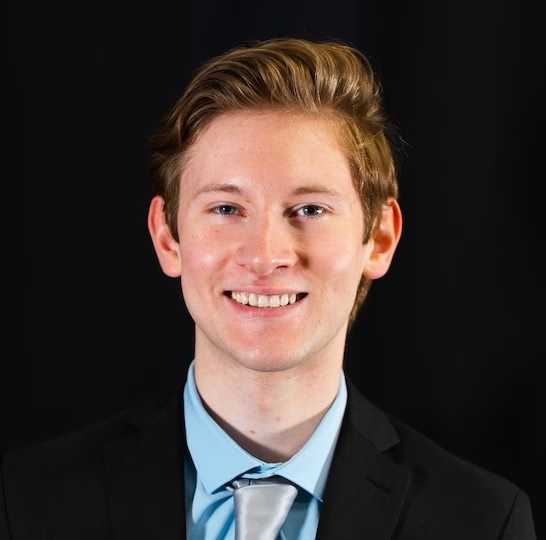 Gabe Dengler-Jeanblanc
The research led to a unique opportunity: Dengler-Jeanblanc met virtually with researchers at Sandia National Laboratories for an in-depth discussion about his project. “That was a really cool experience, to be a student in my junior year and to lead a dialog with these experts in the field,” he says. “They were very helpful in assisting me with the model I was working on so I could progress with the research.”
After a few more months of work, Dengler-Jeanblanc completed the model and generated some notable findings. With Lindley’s encouragement, Dengler-Jeanblanc submitted a successful proposal to the 2024 ANS annual conference to present his research.
“Presenting my work in person at the ANS conference in Las Vegas was an unforgettable experience,” he says. “As an undergrad, I felt like a minor league player going up to the major league for the first time. It was really one of the most satisfying things I’ve done in my academic career, and I’m very excited to do more presentations in the future.”
With this rewarding experience under this belt, Dengler-Jeanblanc was excited to dive into a new research project as a member of Lindley’s group—a large multi-university project studying how using accident-tolerant fuel could enable an existing nuclear power plant to increase its licensed power level. Dengler-Jeanblanc is modeling unique fuel assemblies in a variety of conditions to ensure operational limits are maintained while searching for improvements to the reactor’s power production.
“Advanced nuclear reactors are cool, but I think pursuing power uprates for the existing fleet can be a much cheaper path to increasing the share of nuclear power in our energy mix,” he says. “Even though my work is just a small part of this huge project, it’s really exciting to be contributing to a group that’s working on research that I believe could open a promising path for advancing nuclear.”
In addition to his research activities, he has been active in the ANS student chapter, which has provided valuable opportunities to connect with other nuclear engineering students at conferences. Dengler-Jeanblanc, who graduated in May 2025 and is pursuing graduate studies in nuclear engineering, says he especially appreciates the strong sense of community fostered by the NEEP department.
“It’s a small major with small class sizes, which has been great because it’s easier to form connections with students and faculty,” he says. “Developing close friendships with my classmates is something I’ve really loved about my educational experience. Not only has it helped me learn more, but we support each other through challenges so we all succeed together.”
Featured image caption: Gabe Dengler-Jeanblanc presents his work at the ANS conference. Submitted photo.