Sam Snyder came to the University of Wisconsin-Madison smitten with the city and campus and confident in his career aspirations: He hoped to work in the aerospace sector, preferably as part of efforts to introduce clean energy elements to the industry.
One hitch in his plan was that the university didn’t offer a formal aerospace engineering major; instead, he could major in engineering mechanics with an aerospace option. Not a dealbreaker for him, but certainly not ideal.
Now, Snyder and the rest of the growing conglomeration of students interested in the aerospace industry can choose a major that fully matches their professional ambitions: The College of Engineering will launch an aerospace engineering undergraduate degree program in the fall 2026 semester. It will be the first such program in the state of Wisconsin.
“I’m super excited that everything’s falling into place,” says Snyder, a sophomore who grew up in Ohio before moving to Shorewood, Wisconsin, just north of Milwaukee, before his senior year of high school.
The new major is the result of a surge in student interest, along with demand for more workforce talent from industry, says Darryl Thelen, the John Bollinger Chair of the Department of Mechanical Engineering, which will house the new major.
While the previous engineering mechanics major with the aerospace option (renamed from astronautics in 2020) typically drew 40 to 50 students a year, roughly 30% of mechanical engineering majors indicated in a 2024 department survey that they would major in aerospace engineering if they could. Mechanical engineering is by far the college’s largest major, with nearly 1,600 students as of the spring 2026 semester.
With the process of creating the new major underway, the department told prospective students during 2024-25 campus visit days that those who started in engineering mechanics would be able to switch to aerospace once it formally launched. Thelen says the number of incoming engineering mechanics majors in 2025-26 increased by 60%.
“It was a little shocking, honestly,” says Thelen, who expects the aerospace engineering major to draw 150 to 200 students a year.
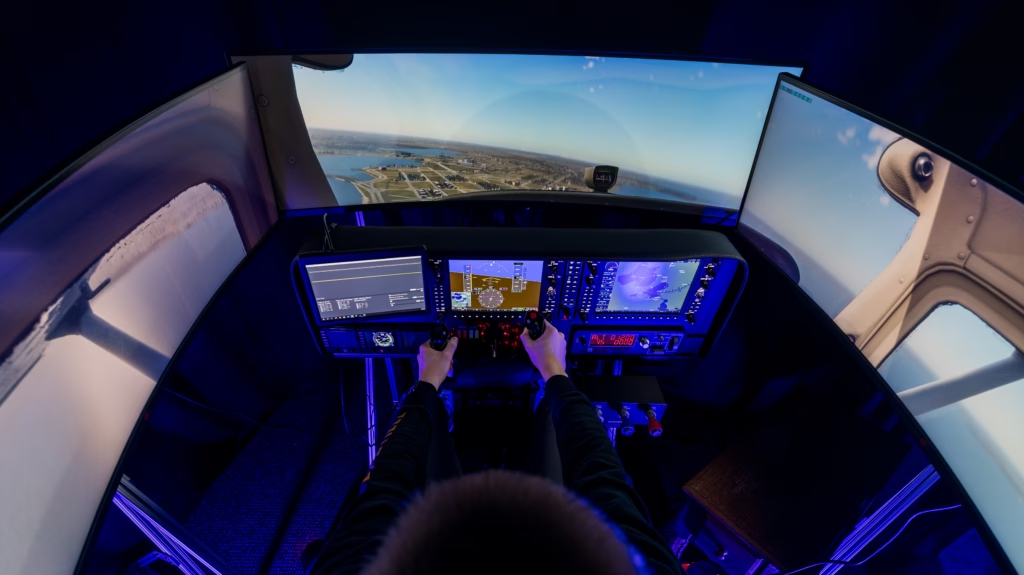 Inside the college’s flight simulator, which was upgraded in 2024.
Work began behind the scenes in 2024, led by Associate Professor Jennifer Franck, William A. and Irene Ouweneel-Bascom Professor Gregory Nellis and Assistant Teaching Professor Arganthael Berson. After benchmarking top aerospace engineering programs from around the country and consulting ABET requirements, the program committee remodeled the previous iteration to include coursework in design and analysis, solid mechanics, dynamics and controls, energy systems and fluid mechanics, capped with two aerospace design courses.
“When you look at aerospace programs around the country, everyone has their own flavor or their own strength,” says Franck, who created a new course for first-year students interested in aerospace in 2024. “One of the discussions we had was, ‘What is our strength at Wisconsin?’ And I think the answer to that is we grew out of an engineering mechanics program, so our strength is in mechanics: fluid mechanics, solid mechanics and dynamics. But also, we can leverage all the strengths we have in mechanical engineering, in design and fabrication, and giving the students access to these awesome clubs. I think the combination is really going to be a fabulous experience.”
In addition to opportunities with student organizations such as the SAE Aero team (which builds small aircraft), Wisconsin Space Program (which is working toward building a liquid rocket) and a raft of robotics and automotive competition teams, students will get hands-on experience with the college’s new educational wind tunnel and upgraded flight simulator.
Isabella Belgiorno, a sophomore from Grafton, Wisconsin, is already looking forward to using the simulator while taking a course in flight dynamics and control in a few years. “Just knowing that I’ll get to actively participate with that in the future is really exciting,” she says.
Thelen says the department hopes to add more instructional facilities in the coming years to keep pace with student enrollment, in addition to research infrastructure. The latter will be tied, of course, to new aerospace-focused faculty hires. The first cluster of those will arrive during the 2026-27 academic year, including Doug Carter, Jacob McFarland, Ioannis Mondralis, Daniel Pickard and Michael Wadas. (McFarland earned his PhD at Texas A&M University under Devesh Ranjan, who’s now Grainger Dean of the UW-Madison College of Engineering.)
“They’re young, ambitious, have a lot of energy and they’re attracted to the idea of coming into a new program and helping to build it,” says Thelen. “And that’s exactly what we need.”
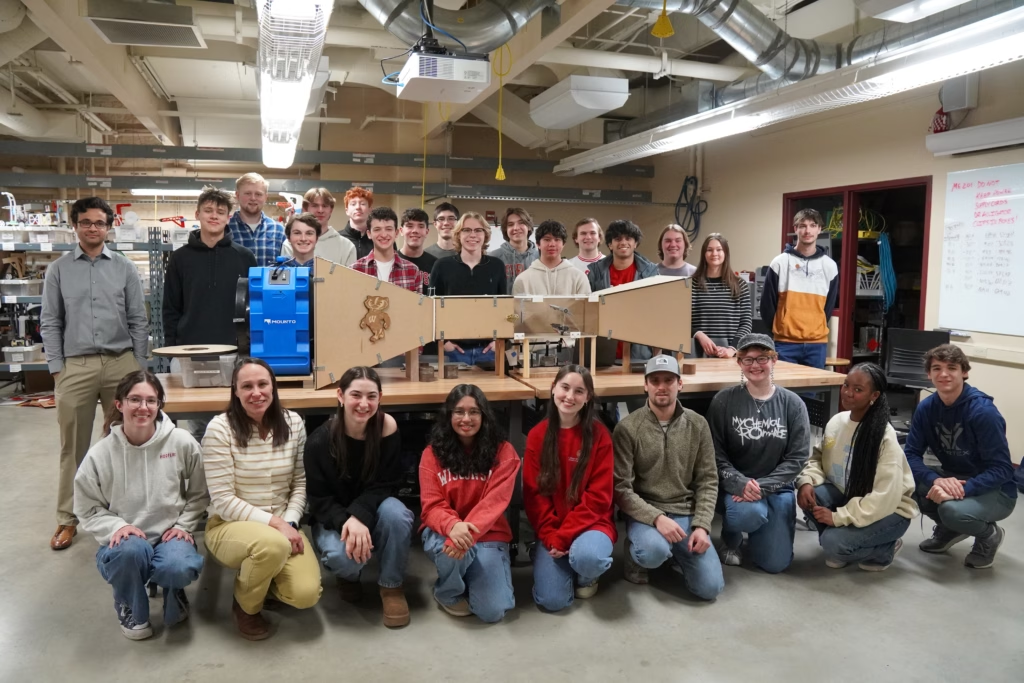 Students in Introduction to Mechanics and Aerospace spent the fall 2024 semester designing and constructing a tabletop wind tunnel.
While Wisconsin doesn’t boast any of the traditional aerospace industry giants, the state is home to more than 200 companies with ties to the sector, according to the Wisconsin Economic Development Corporation. UW-Madison graduates dot the organizational charts at the likes of Boeing, NASA, SpaceX and more, and the possibilities for aerospace engineers extend beyond space and flight-focused companies to other sectors with an interest in aerodynamics, fluid mechanics or, more broadly, computational modeling and analysis.
“Whether you’re talking airplanes, whether you’re talking car manufacturers, I think there are lots of opportunities,” says Brent Schultz (BSEMA ’03), a program manager at Boeing and member of the mechanical engineering department’s industrial advisory board. “I think there are some misleading ideas that if you have an aerospace degree, you can only work for Boeing or some large aircraft company or space program. But that’s not true at all. All the car manufacturers are doing aero work as well. Some people get into the aero field just because they want to work with cars. I think there’s a lot more opportunity there than there was even 10 to 15 years ago.”
Tarundeep Suri (MSIE ’05), vice president and head of global supply chain, engine maintenance and component overhaul operations at United Airlines and another advisory board member, notes another benefit to pursuing an aerospace engineering degree: In the age of artificial intelligence, aerospace careers are less likely to face near-term disruption.
“This field will continue to grow,” says Suri. “There is a lot of hands-on experience, hands-on work that you cannot replace with AI.”
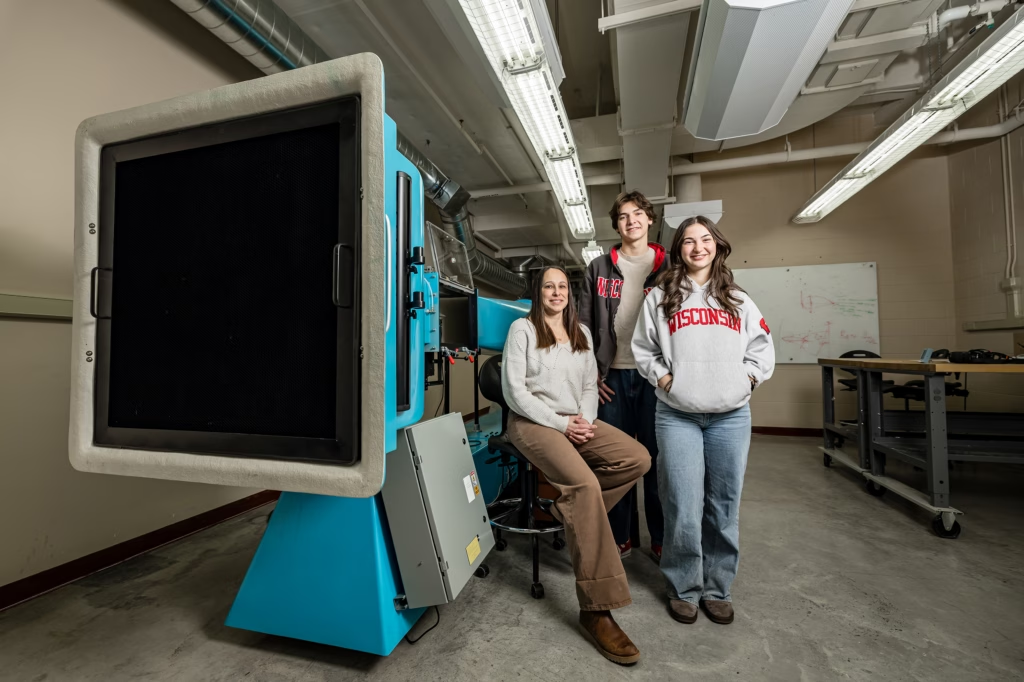 Associate Professor Jennifer Franck, left, and undergraduate students Sam Snyder, middle, and Isabella Belgiorno pose in front of the college’s new educational wind tunnel. Photos: Joel Hallberg
Top photo caption: Sophomore Sam Snyder, shown working with the wind tunnel, has worked as a teaching assistant for Introduction to Mechanics and Aerospace.