One of the major draws for students selecting the University of Wisconsin-Madison is the chance to not only learn from some of the world’s most innovative scholars but also the chance to work side by side with them as an undergraduate researcher.
Undergraduates have done creative and important research in electrical and computer engineering laboratories for decades, gaining valuable skills that lead to successful careers in industry and academia.
That’s why, with the resources of the new alumni-sponsored ECE Undergraduate Research Support Fund, faculty and staff in ECE are working to develop a community of undergraduate researchers in the department and show other ECE students how working in a research lab can supercharge their education.
“We want to facilitate community-building among our undergraduate researchers and connect faculty to them,” says ECE Associate Professor Jennifer Choy, who is spearheading the outreach effort along with Associate Professor Kassem Fawaz, ECE’s Associate Chair for Research. “We basically want to get people excited about the opportunities for undergraduate research.”
The inaugural event in the effort was the first ECE Undergraduate Research Symposium. The team put out a call for undergraduates who wanted to present their research. Any and all ECE-related research was welcome, as long as it was done independently and not as part of course work.
On April 25, 2025, 33 undergraduate researchers and teams presented posters to a crowd of faculty, staff, students and the alumni who comprise the ECE advisory board in Union South. The work was judged by a panel of 11 faculty members from a wide range of disciplines.
Fawaz says all of the research—as expected—was very high quality. “But their presentations were also very high quality,” he says. “That’s the point I want to make; the scoring was extremely close. We had strong posters in AI and machine learning, sensing, data, energy systems, computer architecture, computer networks. They covered all the areas ECE offers, which is actually pretty cool.”
Gavin Kunesh and Ethan Ewer, who work with Lynn H. Matthias Professor Emeritus Barry Van Veen, won the $1,000 first prize for a poster titled “Classification of Human Sleep Data into Consciousness States.” As a testament to the high quality of the posters, there was a three-way tie for the $500 second prize: Henry Czupryna, who works with Grainger Institute for Engineering Professor Daniel Van Der Weide for “Cost-Effective Capacitance Sensor Platform for Wearable IoT Applications”; Tianyang Huang, who works with Jack St. Clair Kilby Professor and Antoine-Bascom Professor Mikhail Kats for his presentation on machine-learning-based automated fitting of ellipsometry spectra; and Aleksandr Kralovec, who works with Melissa Skala, the Carol Skornicka Chair in biomedical engineering, for “Autofluorescence Lifetime Imaging of Metabolism in Progenitor-derived Neutrophils.”
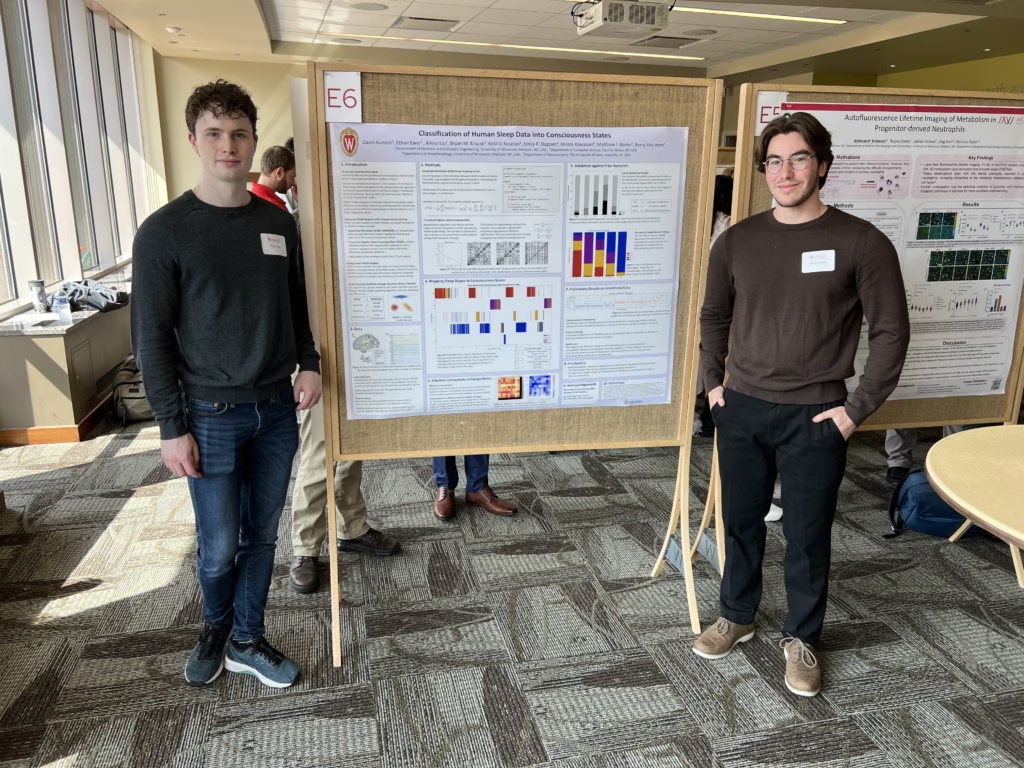 Undergraduate students Ethan Ewer (left) and Gavin Kunesh won first place. Photos: Allyson Crowley
Besides allowing students to show off their hard work, the symposium was intended to “be an experience where students could basically learn how to present and get their advisors’ input in preparing their posters,” says Choy. “One of our goals is for students to communicate effectively with researchers working in a completely different field. We came up with a rubric that is disseminated to all students to guide their preparation, that focuses on organization and clarity in communication. We wanted to make sure the students had a good time communicating the research and could make others appreciate the work they do.”
In fact, after listening to a student working with ECE Assistant Professor Robert Jacobberger at the symposium, Choy realized some of their new techniques on surface chemistry complemented her own research. Now, Choy and Jacobberger’s students are setting up a collaborative research project.
By all accounts, the symposium was a success, with students engaging with one another and faculty to build a more robust research community. ECE plans to keep the momentum going with another undergraduate research symposium in spring 2026.
The department is also exploring other efforts to encourage and support undergraduate research. Last year, alumni donors Jay and Han Wang sponsored the first Hilldale Undergraduate Research Fellowship dedicated to ECE students, and Professor Emeritus Fernando Alvarado and Carla Alvarado along with Grainger Institute for Engineering Associate Professor Line Roald launched the Alvarado Sustainability Scholars, a program that supports a community of undergraduate researchers in energy and sustainability.
In addition to hosting an annual research symposium, the department is also developing an undergraduate research fellowship to support outstanding young researchers.
To support undergraduate research in ECE, visit the UW-Madison Foundation or contact Development Director Courtney Spilker, (608) 590-9722.